Specialist teacher and assessor of Dyscalculia and Dyslexia

FAQ SpLD Assessment

I specialise in school aged children.   

You can complete this form Request for Screening and then you will be taken to the diary to book a suitable time.

Or if you would like to have a chat first please call Jan on 0238 104 0108 who will be happy to discuss and explain the process.

At Southampton Tuition Centre, please see Get in Touch for directions.  There is dedicated parking.

You can complete this form Request for Diagnostic Assessment

This form takes you to the calendar where you can select a suitable day for the tests.  These are term time and usually mid-week although in exceptional circumstances alternative days such as Saturday afternoons might be occasionally available.

There needs to be a minimum of 3 weeks preparation time before the testing days for all the information to be gathered and compiled from yourself and your child’s school.

If you would like to have a chat first please call Jan on 0238 104 0108 who will be happy to discuss and explain the process.

The price from 1st January 2026 is £650 for one condition or £900 for an investigation into both literacy and numeracy.

A deposit of 50% is payable when booking to secure your assessment date.  The investigation starts immediately with requests for background information, contacting your child’s school and reviewing any existing reports.  This is important as the selection of tests used is based upon the information you provide.

All information must be received at least 3 weeks before the appointment for testing.

The final payment is due before the report has been drafted and is ready to send.

Reports are written according to the current guidelines by The SpLD Assessment Standards Committee (SASC) who are the governing body of Specialist Assessors who hold Assessment Practicing Certificates.

The reports have to conform to their guidelines and include the following sections:

  • Overview including diagnostic outcome
  • Background, Health & Development, Educational History and Current Situation broken down into a number of pertinent subheadings
  • Testing explanations and findings
  • Recommendations
  • Appendices

The reports are usually about 30 pages long and quite detailed.

Once finalised you can share the report with your child’s school and any other professionals.  This will enable them to tailor your child’s support to their specific needs.

If your child has other difficulties it may form part of the evidence to apply for an Educational Health Care Plan.

When they go to university the report can be used to support their application for support via the Disabled Students Allowance.

If you already have had a diagnosis of dyslexia done but require further investigation into dyscalculia then a new investigation focussing on mathematics can be undertaken.

If you require both dyslexia and dyscalculia to be investigated then it is better to get them tested for together as many of the tests are the same.

Sorry, no.

There are a number of reasons why but mainly it’s to avoid distractions.

The tests are developed under strict conditions and standardised accordingly (also copywritten).  In order to be valid they should be administered in the same way as they were developed so others are not allowed to be present, only the qualified assessor and the person being assessed.  Not following this could invalidate the results.

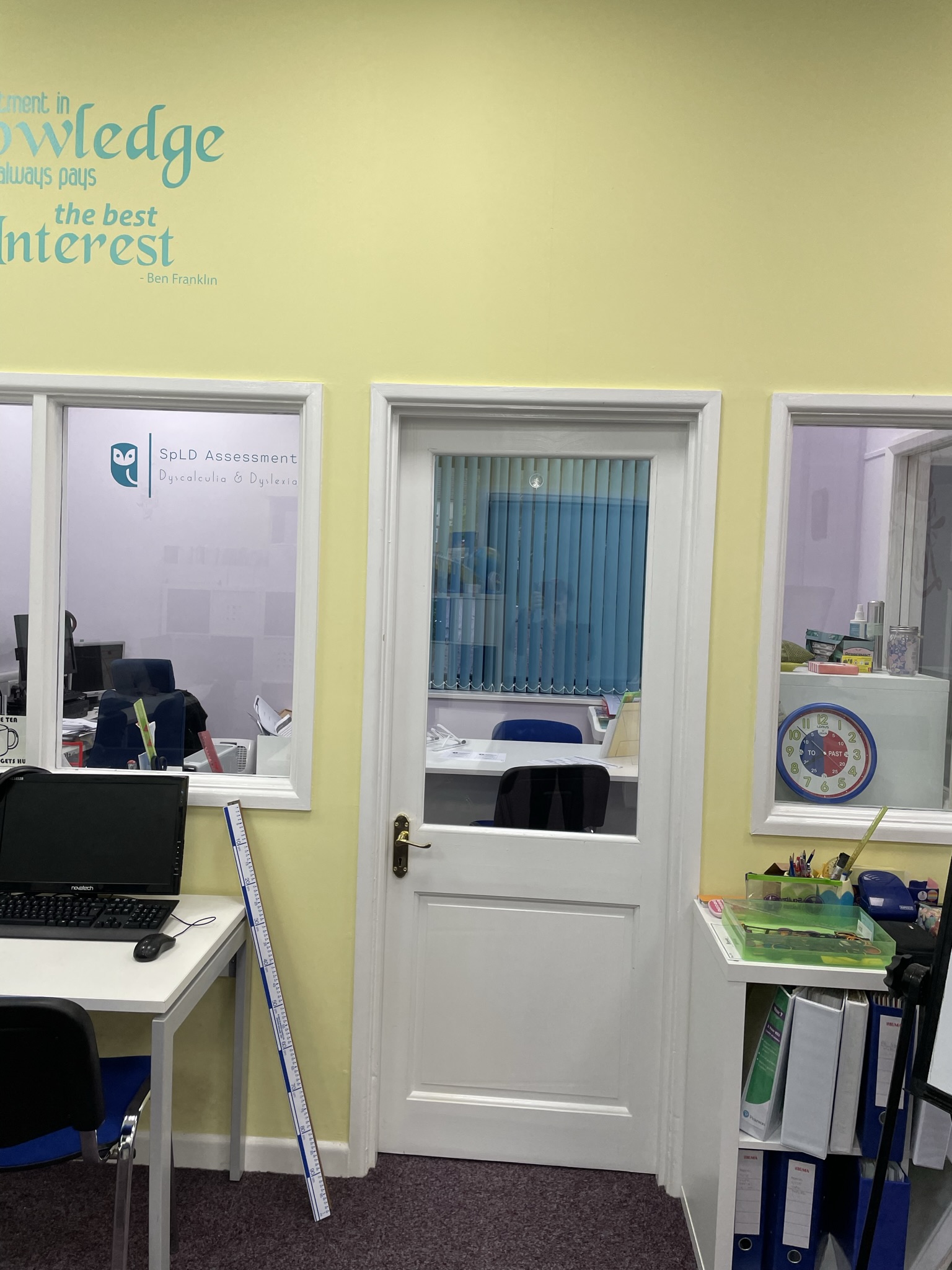
However, the room has windows and you wait in reception so you’re child knows you’re near by.

We also have breaks so they will come out to have a snack etc.

You will be sent links to some questionnaires.

In order to get input from your child’s school there is a ‘permission to share’.  The school will then be emailed and asked to complete a questionnaire about your child and their school achievement, any difficulties etc.

The family background questionnaire that you complete is essential to establishing you child’s difficulties.  SpLDs are developmental therefore knowing if your child has had health issues, eyesight, hearing or any major periods of illness that impacted school is important to determining any factors that have impacted their achievements.

There is a visual screening conducted to identify if visual stress might be a factor.  Should it be identified that this might be an issue you can be referred to an optometrist.

A neurodiversity checklist is used to identify if other conditions might be involved in your child’s difficulties.

Please complete these with as much detail as possible.  Ideally sit down with your child and their other parent (or carers) if possible to fill these in.  The more information you provide the better.  This isn’t a 5 minute job, be prepared to spend an hour or so as the diagnosis has to be supported by evidence of both strengths and difficulties.

Yes, but that is really down to the examination centre (the school).  If they would like me to complete part 2 of the form 8, then they need to have a working relationship with me prior to me conducting any testing and send me the already completed part 1.  There might be an extra charge for this service.  

I work for schools as an independent exam access arrangements assessor.  Any school requiring this service should contact me for availability and prices.

No, please don’t.

It is important that the tests are free from interruption.

Other children would be bored and noise must be kept to a minimum so the sound (or knowledge) that a sibling is playing on a tablet can be enough to cause distraction.

Yes, you are very welcome to bring a laptop to work on whilst the testing is being conducted.   There is an area where you can plug in and work quietly.

© Copyright 2023